
Bloga
Choosing the right mobile light tower for a large construction or infrastructure project involves more than comparing lamp wattage or maximum brightness. Project managers need to consider the illuminated area, operating hours, power supply, mast height, site conditions, mobility, and long-term maintenance requirements.
For road construction, bridge projects, mining operations, railway construction, and large industrial sites, a suitable mobile light tower provides consistent illumination across active work areas while supporting safer nighttime operations. The best choice depends on how the equipment will be used, how frequently it needs to be relocated, and whether the site has access to an external power supply.
This guide explains how to choose a mobile light tower for large construction and infrastructure projects, compares different power configurations, and highlights the technical specifications that procurement teams should evaluate before purchasing.
Large construction projects often involve multiple work zones, extended operating schedules, and changing site layouts. Fixed lighting systems may not provide sufficient flexibility when construction activities move from one location to another.
A mobile lighting tower offers a practical solution by combining elevated lighting fixtures, a telescopic mast, and a transportable base or trailer. Depending on the configuration, it can provide independent illumination for different working areas without requiring permanent lighting infrastructure.
Mobile light towers are commonly used in:
For contractors managing multiple work fronts, mobile lighting equipment can also reduce the need to install permanent lighting at temporary work locations. Its transportability makes it easier to adapt lighting arrangements as the project progresses.
Lighting performance should be one of the first considerations when selecting a construction light tower. However, a higher lumen rating does not automatically mean better illumination across the entire worksite.
Buyers should evaluate several related specifications:
For large construction sites, the objective is to achieve sufficient and reasonably uniform illumination across the actual working area, rather than simply maximizing the lumen rating.
For example, a mobile light tower equipped with four LED fixtures can provide a different lighting arrangement from a unit with fewer, higher-powered lamps. The final result also depends on fixture orientation, mast height, surrounding structures, and the distance between lighting units.
Before purchasing, ask the manufacturer for photometric data or an illumination layout based on your project area. This helps determine how many towers are required and where they should be positioned.
The mast determines how high the lighting fixtures can be positioned above the ground. For large infrastructure projects, sufficient mast height helps distribute light over a wider area and reduces some of the shadows created by nearby equipment and structures.
When comparing mobile light towers, consider:
Manual lifting systems can be suitable for projects where lighting equipment is repositioned occasionally and straightforward operation is preferred. Electric or hydraulic lifting systems can be more convenient when frequent mast adjustment is required.
For example, KEYPOWER's KPLT-L1600E features an electric lifting system and a maximum mast height of 7.5 meters. The KPLT-B1600H uses a hydraulic lifting system and offers a maximum mast height of 9 meters.
These configurations illustrate why buyers should compare the lifting mechanism and mast height together rather than evaluating either specification independently.
Explore the KPLT-B1600H LED Light Tower for a hydraulic mast configuration designed for outdoor lighting applications.
The power source directly affects where and how a mobile light tower can operate. For large construction projects, the right configuration depends on the availability of electricity, operating schedules, fuel logistics, and environmental requirements.
Diesel-powered mobile light towers
Diesel-powered models are suitable for remote construction sites and projects that require extended operation without relying on a fixed electrical connection. Their integrated generator provides power for the lighting system, making them a practical option for highway construction, mining, and large infrastructure developments.
When selecting a diesel light tower, check the engine model, generator output, fuel tank capacity, fuel consumption, and operating hours under the specified load.
Solar-powered mobile light towers
Solar-powered models use photovoltaic panels and battery storage to supply energy to the lighting system. They can reduce fuel consumption and local exhaust emissions during operation, making them attractive for sites with environmental restrictions or lower noise requirements.
However, solar performance depends on sunlight availability, battery capacity, charging conditions, and daily lighting demand. Buyers should verify the actual operating time under the expected weather and usage conditions.
Grid-powered or externally powered lighting systems
Where a stable electrical supply is available, externally powered lighting equipment may reduce the need for an onboard generator. This configuration can be appropriate for established construction sites, industrial facilities, and locations where low operating noise is important.
The power source should always be selected according to actual site conditions rather than purchase price alone.
Long operating hours are particularly important for projects running overnight or across multiple shifts. A light tower that requires frequent refueling or recharging can increase labor requirements and interrupt construction activities.
For diesel-powered models, compare fuel tank capacity, engine efficiency, and continuous operating time. Make sure the manufacturer's stated runtime corresponds to a clearly defined operating condition, as fuel consumption can vary with load and operating environment.
For solar-powered equipment, evaluate battery capacity, solar panel output, charging time, and expected nighttime runtime. It is also important to consider whether the system can maintain sufficient battery charge during consecutive cloudy days.
For reference, KEYPOWER offers different configurations:
These figures are model-specific reference specifications. Actual runtime should be confirmed against the intended operating conditions and supplier documentation.
Large construction sites rarely remain unchanged throughout a project. Lighting equipment may need to move between excavation zones, temporary roads, material storage areas, and other work locations.
A suitable mobile light tower should therefore have a practical transportation and positioning design.
Important considerations include:
Buyers should also confirm whether the trailer is compatible with their towing vehicles and local road regulations. A mobile light tower designed for easy transportation can simplify equipment relocation and improve the efficiency of site operations.
Outdoor construction equipment must withstand changing weather conditions, including rain, dust, wind, and temperature fluctuations.
Before selecting a tower, review the following specifications:
Wind resistance is particularly important for tall lighting towers. The equipment should be operated within the manufacturer's specified wind limits, with the mast lowered when required by the operating manual.
For example, KEYPOWER's KPLT-L600MS features an IP65 protection rating for its specified lighting equipment and a galvanized construction. Buyers should confirm the protection rating of each relevant electrical component rather than assume it applies to the entire machine.
Different construction environments have different lighting and power requirements. The following comparison can help contractors narrow down their equipment choices.
| Project Type | Recommended Configuration | Main Considerations |
|---|---|---|
| Highway Construction | Diesel-powered LED tower | Long runtime, mobility, wide illumination |
| Bridge Construction | High-mast LED tower | Mast height, stability, adjustable lighting |
| Remote Infrastructure Sites | Diesel or solar-powered tower | Independent power supply, operating time |
| Environmentally Sensitive Sites | Solar or externally powered LED tower | Local emissions, noise, charging conditions |
| Mining Operations | Heavy-duty diesel LED tower | Durability, weather resistance, maintenance |
These are general equipment selection guidelines rather than fixed rules. Actual requirements depend on site layout, lighting standards, operating schedules, and available infrastructure.
KEYPOWER provides several mobile light tower configurations for outdoor lighting applications. Comparing their specifications helps buyers identify which design is more suitable for their project requirements.
The KPLT-L1600E is a diesel-powered LED lighting tower equipped with an electric mast lifting system. It is designed for applications where convenient mast adjustment and extended operating time are important considerations.
This model can be considered for construction and infrastructure projects that need a diesel-powered lighting solution with electric mast adjustment.
View the KEYPOWER KPLT-L1600E Mobile LED Light Tower for further specifications.
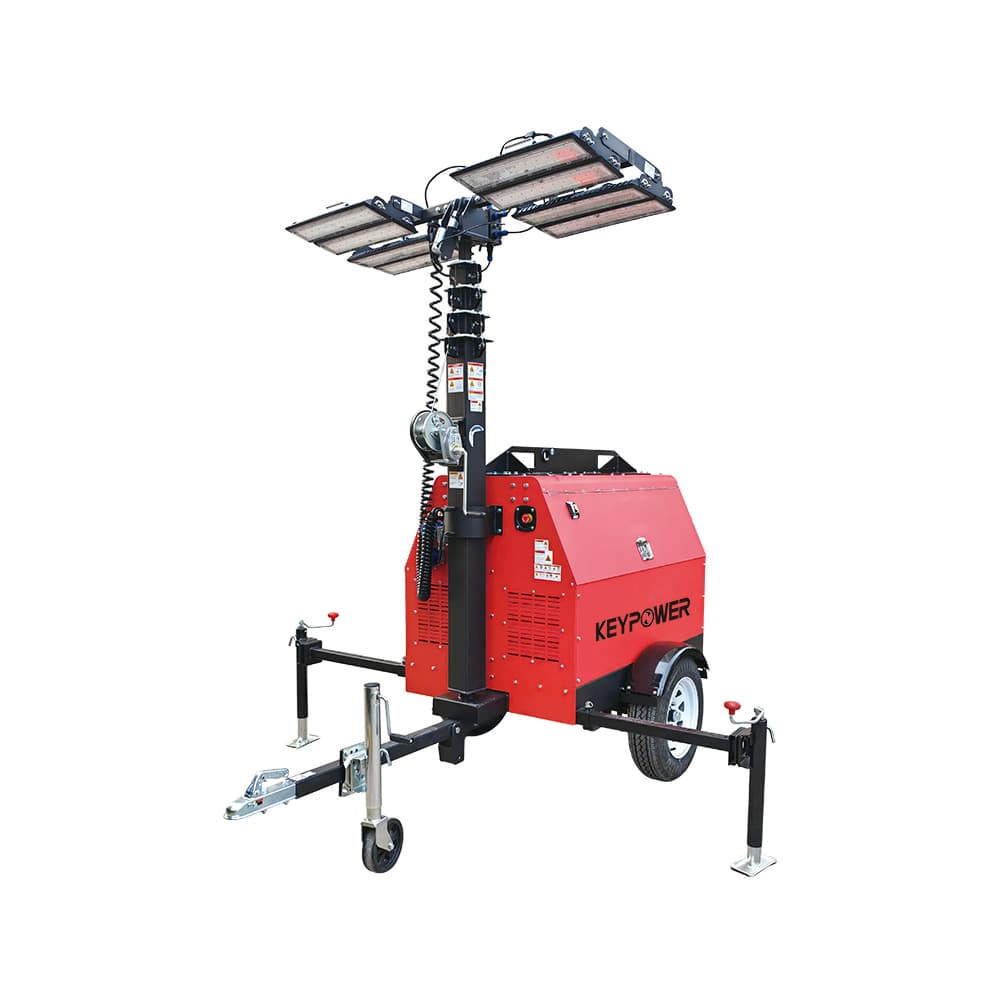
The KPLT-L1600C is another diesel-powered configuration featuring four LED floodlights and a manual telescopic mast. Its fuel tank and stated operating time make it worth evaluating for projects that require extended lighting operation.
Its manual mast system provides a straightforward alternative for projects where electric lifting is not a primary requirement.
View the high brightness mobile light tower for more information.
The KPLT-B600S is a solar-powered mobile light tower designed for applications where reducing dependence on conventional fuel-powered generation is a priority.
This model can be considered for remote locations and projects where solar charging conditions and battery capacity can support the required nighttime lighting schedule.
Determining how many mobile light towers a construction project needs is an important part of equipment planning. Purchasing too few units may leave certain work areas inadequately illuminated, while purchasing too many can increase equipment and operating costs.
A practical assessment should start with the following information:
A preliminary estimate can be made using the following relationship:
Estimated number of light towers = Total required light output ÷ Effective light output per tower
This is only a preliminary planning concept. The actual calculation should account for utilization factors, light distribution, mounting height, beam angles, and site conditions.
For example, a large highway construction project may require separate lighting arrangements for paving operations, material storage, machinery parking, and temporary access roads. Instead of relying on one powerful tower, contractors may achieve better coverage by positioning several units strategically.
For accurate planning, request a lighting layout or photometric calculation from the equipment supplier. This provides a more reliable basis for determining the required number and placement of towers.
The initial purchase price is only one part of the total cost of owning a mobile light tower. For large construction projects and equipment rental companies, operating and maintenance costs can have a significant impact on long-term value.
Before making a purchasing decision, evaluate the following factors:
For diesel models, fuel consumption and maintenance intervals deserve particular attention when the equipment will operate for extended periods. For solar-powered models, battery replacement costs and charging performance should be included in the evaluation.
Comparing the total cost of ownership over the expected service period provides a more realistic picture of equipment value than comparing quotations alone.
Choosing a suitable product is only part of the purchasing process. Contractors, distributors, and equipment rental companies should also evaluate the manufacturer's ability to provide reliable technical information and after-sales support.
Before placing an order, consider asking the supplier:
A professional supplier should be able to explain the differences between models and recommend equipment based on actual project requirements rather than simply offering the highest-powered option.
KEYPOWER was established in 1998 and operates a manufacturing facility in China covering more than 66,000 square meters. With a product range that includes diesel generators, load banks, and light towers, KEYPOWER provides power and lighting equipment for a variety of industrial and construction applications.
For project-specific requirements, buyers can explore the KEYPOWER mobile light tower product range or contact the team to discuss suitable configurations.
Before confirming a purchase, use the following checklist to make sure the selected equipment matches your project requirements.
The right mobile light tower is not necessarily the one with the highest wattage or the largest specifications. It is the one that delivers suitable illumination, reliable operating performance, and practical mobility under the actual conditions of the project.
By comparing lighting performance, power configuration, runtime, structural stability, and total ownership costs, construction companies can make more informed equipment purchasing decisions.
If you are sourcing mobile light towers for construction, infrastructure, mining, or equipment rental applications, contact KEYPOWER to discuss your project requirements and explore suitable lighting solutions.
A mobile light tower provides temporary outdoor illumination for construction sites, roadworks, mining operations, infrastructure projects, industrial maintenance, and emergency response activities. Its portable design allows lighting to be moved between different working areas.
The required lumen output depends on the working area, mounting height, beam angle, and required illuminance. Buyers should evaluate both total luminous flux and lux levels across the work surface instead of selecting equipment based on lumens alone.
Diesel mobile light towers use an onboard engine-generator system to power the lights and are suitable for remote sites requiring extended operation. Solar mobile light towers use photovoltaic panels and battery storage, reducing fuel dependence and local exhaust emissions. The choice depends on energy availability, weather conditions, and operating schedules.
Operating time varies by model, power source, load, and operating conditions. For example, KEYPOWER's KPLT-L1600C has a stated continuous operating time of up to 70 hours, while the KPLT-L1600E is listed with up to 90 hours. The KPLT-B600S solar model has a stated working time of 12–16 hours.
The suitable mast height depends on the size of the work area, surrounding structures, and lighting distribution requirements. Towers with 7–9 meter masts are available in KEYPOWER's product range, but the final selection should be based on site-specific lighting calculations.


 IPv6 obsługiwana sieć
 Polski
 Polski
 English
 français
 Deutsch
 русский
 español
 português
 Nederlands
 العربية
 中文
